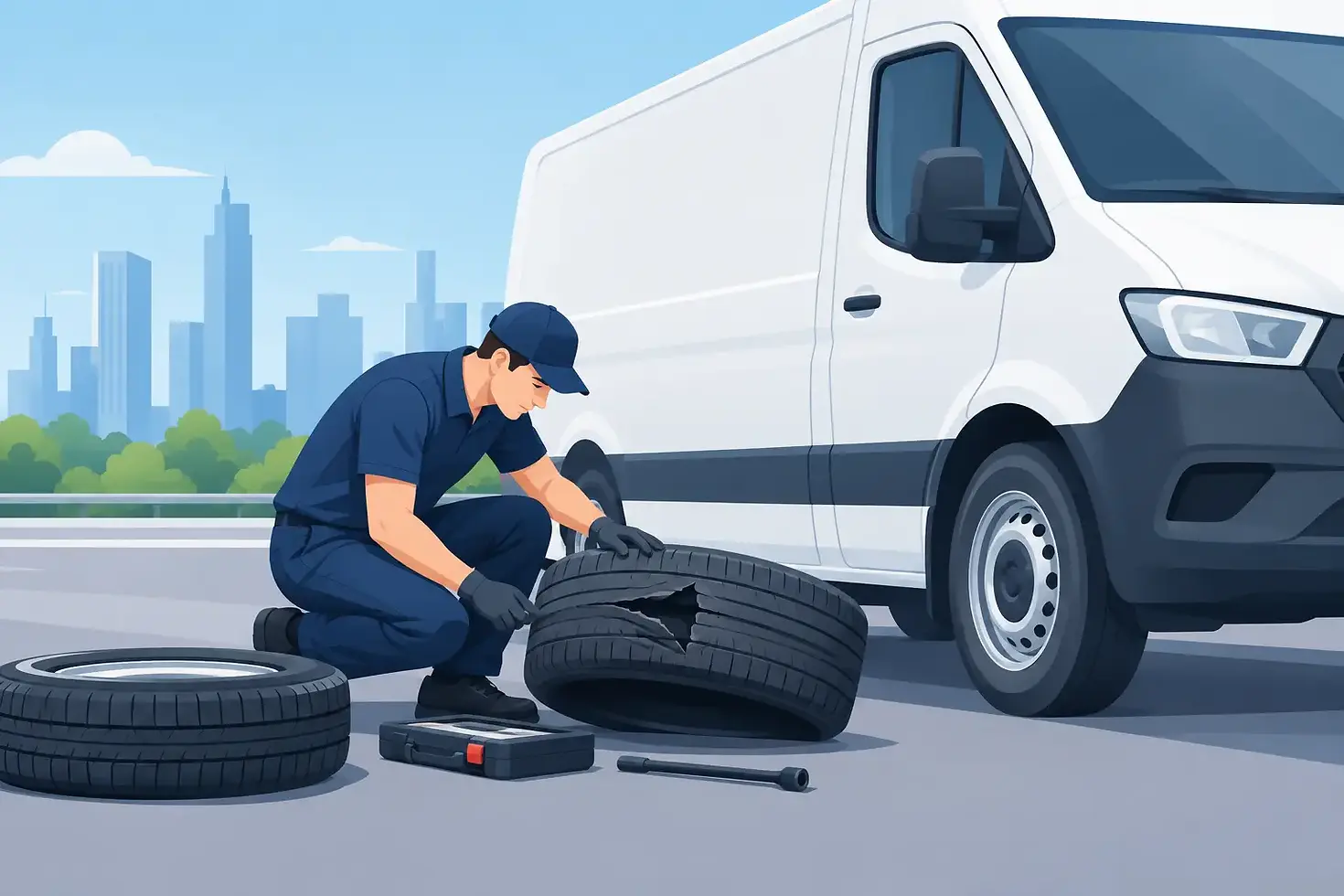
Courier Tyre Failures: Prevent Downtime Fast
A courier van can complete dozens of stops without issue, then lose an entire shift because of one damaged tire. Courier tyre failures are rarely just bad luck. High mileage, heavy loads, curb contact, underinflation, and rushed inspections often build toward a roadside problem long before the tire finally gives way.
For delivery operators, a flat or blowout affects more than one vehicle. It delays customers, disrupts route planning, puts pressure on drivers, and can leave urgent loads stranded. The right response combines immediate roadside safety with a maintenance routine built around the demands of commercial work.
Why courier tyre failures happen so often
Courier vehicles place unusual demands on their tires. A family car may cover modest mileage with long breaks between journeys. A delivery van can spend all day stopping, turning, braking, reversing, and carrying changing loads. That repeated low-speed work creates heat, wear, and sidewall stress in ways that are easy to underestimate.
Underinflation is one of the most common causes. A tire that is even slightly low flexes more as it rolls, generating excess heat and wearing its shoulders faster. On a loaded van, that heat can damage the internal structure of the tire. It may not fail immediately, but it becomes far more vulnerable to a puncture, tread separation, or sudden deflation.
Overloading creates a similar problem. Every tire has a load rating, and the rating matters most when a vehicle is carrying parcels, tools, stock, or equipment all day. Exceeding the vehicle's payload limit, or loading weight unevenly, puts excessive stress on the rear tires and can affect handling under braking.
Road conditions also play a major role. Potholes can pinch a tire against a wheel rim, causing internal damage that is not always visible from the outside. Curbs can cut or bruise a sidewall. Construction debris, screws, and broken metal frequently cause slow punctures that become a full flat during the next delivery run.
Early warning signs drivers should not ignore
A tire rarely gives a useful warning at a convenient time. That is why drivers need to recognize smaller changes before they become an emergency. A vehicle pulling to one side, vibration through the steering wheel, a new thumping sound, or a tire pressure warning should be checked promptly rather than left until the end of the route.
Visible damage matters too. Look for cuts, bulges, cracking, exposed cords, objects embedded in the tread, and uneven wear. A bulge in the sidewall is especially serious because it can indicate broken internal cords. That tire is not safe to repair or keep in service, even if it still holds air.
Uneven tread wear can point to a fault beyond the tire itself. Wear concentrated along the inner or outer edge may indicate incorrect wheel alignment, worn suspension components, or regular curb impact. Cupped or scalloped wear can suggest an issue with balancing or suspension. Replacing the tire without diagnosing the cause can mean the replacement wears out prematurely.
For fleet managers, recurring tire problems on the same vehicle should be treated as a maintenance signal, not a string of isolated incidents. Accurate inspection records help identify whether the cause is driver behavior, route conditions, loading practices, alignment, or a mechanical issue.
What to do when a courier tire fails on the road
When a tire loses pressure, the first priority is control. Keep a firm grip on the steering wheel, ease off the accelerator, and avoid sharp braking or sudden steering inputs. If the vehicle is stable, signal and move to the safest available location away from moving traffic. Turn on hazard lights and assess the surroundings before leaving the vehicle.
Do not continue driving on a flat tire simply to reach the next stop. Even a short distance can destroy the sidewall, damage the wheel, and turn a repairable puncture into a required replacement. It can also reduce control of a loaded van at exactly the moment predictable handling is needed.
A spare tire can be useful, but it is not always the best operational answer. Many modern vans have no full-size spare, and temporary spares have speed and distance limits. Fitting one beside a busy road also creates risk for the driver. A mobile tire technician can inspect the damage, determine whether a safe repair is possible, and fit a correctly rated replacement at the vehicle's location.
This is particularly valuable for urgent delivery work. MobileTyreXpert provides on-site diagnosis and emergency fitting so drivers in the Bournemouth area can avoid the added delay of arranging a tow or traveling to a tire shop on a compromised wheel.
When a puncture can be repaired
Not every puncture means a new tire. A repair may be possible when the damage is within the central tread area, the hole is small, and the tire has not been driven while flat. The tire must also have sufficient remaining tread depth and no internal, sidewall, or bead damage.
The location of the puncture is critical. Damage in the shoulder or sidewall is generally not suitable for repair because those areas flex heavily. Likewise, a tire with a bulge, exposed cords, or signs of running flat must be replaced. A plug inserted from the outside may appear to solve the leak, but it does not replace a proper professional inspection and repair process.
For courier vehicles, the trade-off is simple: a repair can reduce immediate cost and preserve a serviceable tire, but only when it meets safety standards. A questionable repair may cost far more in missed deliveries, wheel damage, or another roadside failure.
Preventing courier tyre failures between routes
The most effective tire program is short, consistent, and practical enough to happen during a busy week. Drivers do not need to perform a workshop-level inspection before every shift, but they should walk around the vehicle and look for obvious damage, low tires, and objects in the tread.
Pressure should be checked when the tires are cold and adjusted to the vehicle manufacturer's recommendation for the actual load being carried. The pressure listed on the tire sidewall is not the normal operating target. It is a maximum rating, not a substitute for the vehicle placard or handbook specification.
Tread depth should be monitored across the full width of each tire, not just the easiest visible section. Legal minimums are not a maintenance target for high-mileage commercial vehicles. Replacing tires before they become marginal provides better wet-weather braking, more predictable traction, and more time to schedule the work without losing a vehicle during a route.
A useful routine includes four checks:
Inspect pressures, tread, and visible sidewall damage at least weekly.
Check for nails, screws, stones, and cuts during the daily vehicle walk-around.
Rotate tires only when the vehicle manufacturer and tire setup allow it.
Arrange alignment and balancing checks after pothole strikes, repeated curb contact, or new vibration.
Seasonal conditions deserve attention as well. Colder weather reduces tire pressure, while hot road surfaces raise operating temperatures. Heavy rain increases the risk from low tread depth and poor alignment. Delivery schedules may not pause for weather, so the tires need enough safety margin to cope with it.
Choosing replacement tires for delivery vans
The cheapest tire is not always the lowest-cost option for a courier operation. A suitable commercial tire should match the correct size, load index, and speed rating for the vehicle. Its construction also needs to suit the work: frequent urban stops, mixed motorway mileage, wet roads, or heavier payloads all influence the best choice.
Premium and mid-range commercial tires can offer better wear consistency, wet grip, casing strength, and fuel efficiency than low-cost alternatives. However, the right decision depends on annual mileage, route type, vehicle weight, and how long the business plans to keep the vehicle. A dependable mid-range tire fitted correctly may be a smarter operational choice than a premium option that does not match the van's use.
Installation quality matters as much as tire selection. Correct mounting, valve inspection or replacement where needed, torque procedures, and precision balancing protect the new tire and help prevent vibration. If wear patterns suggest an underlying fault, alignment or suspension diagnosis should happen before the vehicle returns to full delivery duty.
A tire failure does not have to derail an entire route. Treat pressure warnings, vibration, and uneven wear as early service requests, not inconveniences to ignore. Fast professional support is valuable in an emergency, but consistent checks are what keep drivers safer, customers informed, and vehicles earning rather than waiting at the roadside.


Comments